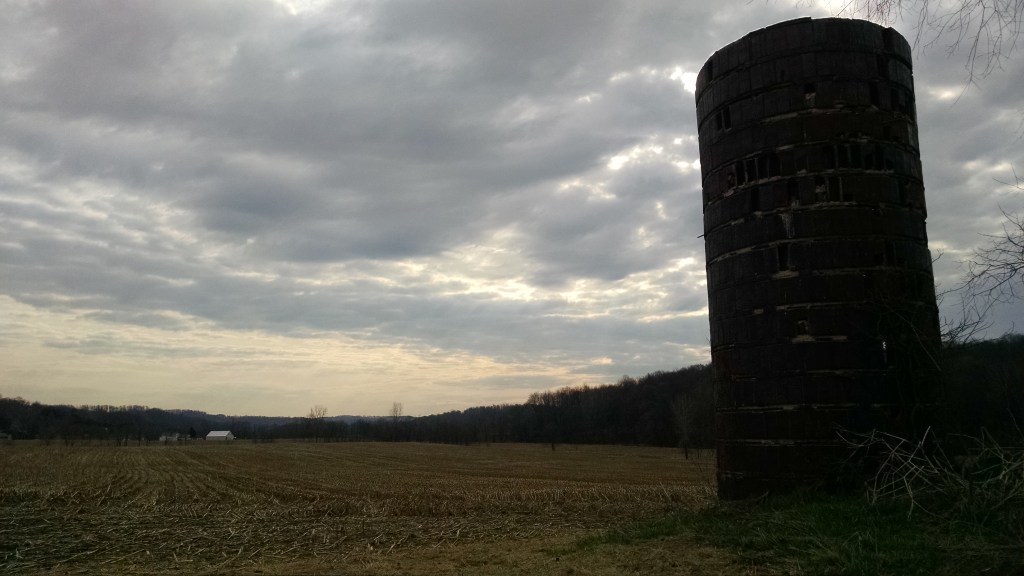
Every few minutes or so, another car passed. More trucks than cars, actually; I’d left town behind and ventured into farm country, where plowed fields like the one captured in this post’s featured image dominate.
People who tend this land need their vehicles for more than transportation. They need to haul feed and equipment. They need Rhino-lined truck beds, 300-plus horsepower engines, reinforced axles.
The longer I stayed, the more anxious I became that one would stop and I’d be called out for trespassing.
At even the faintest rush of approaching traffic, I pointed and shot whatever was in front of me, then glanced to the mouth of the lane, preparing myself to leap out of the brush in case the car or truck happened to pull off the road and growl down to where I’d parked my Vibe.
I imagined the scene that would follow:
The driver would roll down his window and ask what the hell right I had to do — whatever I was doing out here.
He’d speak firmly and without hesitation. He’d be wearing sunglasses, or else he’d have a ball cap with a tightly-rolled and curled bill pulled low over clear eyes and grizzled cheeks.
“I’m just taking pictures,” I’d say. “I didn’t think anyone would mind.”
I had good reason to think so. The land is overgrown. The house has been abandoned a couple decades at least. Its windows have been shattered. The roof over the porch has fallen in, its beams exposed; while I approached and photographed the porch banister, some plastic sheeting that had gotten caught on the head of an exposed nail flapped in a loose wind.

I’ve often felt this way about my creative pursuits, writing, blogging; I used to feel the same way about running when I was an avid, every-day-rain-or-shine runner. I felt that any responsible person would say I was wasting my time, doing something useless.
These feelings about my pursuits came from no one in particular; it would be more accurate to say they came from the worst I could imagine others thinking of me. As if I’d already failed them — everyone, my friends, family. Everyone. I felt small. Still do at times. Especially when it’s difficult to show the value of the work.
It’s been ages since my last publication. I’ve had trouble finishing anything, and every completed poem or story seems wrong for any number of reasons. Perhaps it doesn’t fit a particular journal’s aesthetic. Or else it’s too long, or too straightforward, or too narrowly focused or too personal.
On top of that — maybe because of that — I’m struggling to remain invested in the characters I’m currently working on.
Teaching presents its own challenges. I feel as incapable of measuring up in the classroom as I do on the page at times. Again, I know these feelings originate inside my own head. I’m as good as anyone at taking one small incident — a student missing class, or an assignment turned in that’s missing one or two elements — and blowing it way out of proportion.

Scale.
As I look back at the images I captured while I trespassed on this abandoned homestead, I begin to see the shape of my own personal struggles with scale. More precisely, I begin to see my problems as problems of scale: I continue making mountains out of mole-hill issues, turning small misses into reasons to question my abilities, purposes, who I am.
Come to East-Central Ohio and you’ll likely drive past more than a handful of sites like this one, where old houses are being swallowed by rampant Nature and silos crumple while creeper vines and seedlings take root in cracks and gouges in the clay.
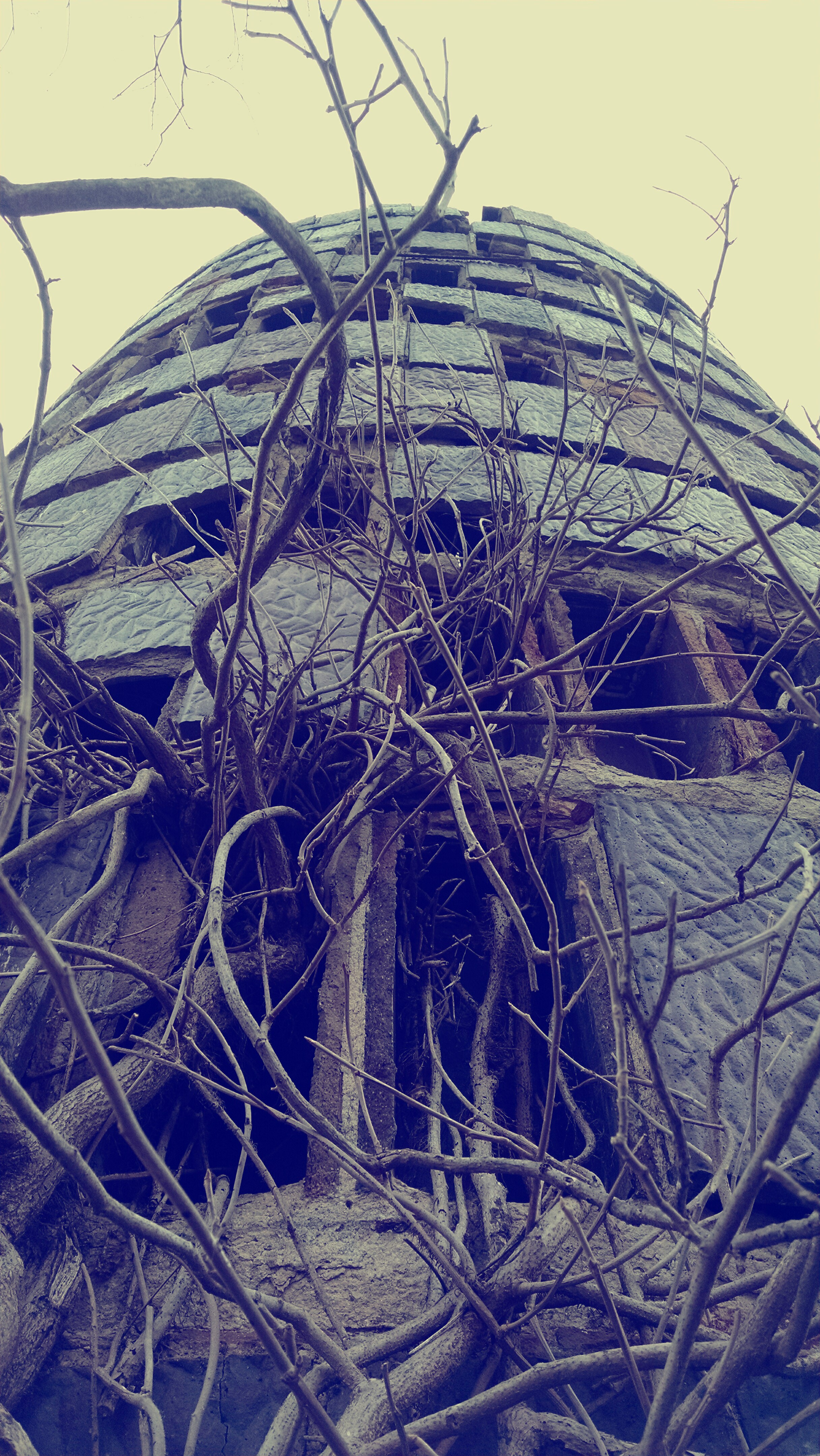
There’s sadness here, and a strong sense that the values which shaped this and other such places have fallen away or have been superseded.
Ways of living change.
Lives change; people choose to live differently. We see this most clearly in what’s left behind.

But for all that loss and sadness and nostalgia, I’ve never felt hopeless at the sight of places like this. What I’ve felt instead — what I felt this afternoon — was grounded. Centered. As if everything in the world had regained proper proportions.
No one stopped. No driver turned off and drove down the lane and demanded to know what I was after. I left after taking a few close-ups of the house — and of the bones in the shot above, which I nearly stepped on walking back to my car.
A deer’s spine and ribcage? I couldn’t — can’t — be sure. Whatever the animal, the remains of its skeleton might have been lying where I photographed them for years and years. Or they might have rested there only a season. Each rib had been picked clean, and the sun had bleached the bones to match the yellowed shades of the dead grass and corn stubble. The bones may symbolize scale more powerfully than either the faded house or the crumbling silo do. I tried to capture the bones’ proportional bigness in the final shot.


 Patrick Faller
Leave a reply to tjparis Cancel reply